












By Ehichioya Ezomon
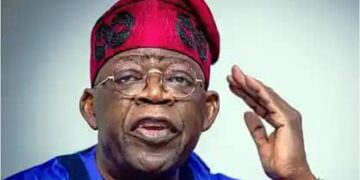
Amid the exigencies, and declaration of a state of emergency on security across Nigeria, President Bola Tinubu, on Wednesday, November 26, 2025, finally approved State Police, which he’s repeatedly pledged its creation, but with a caveat: It’s only for states that require its establishment.
In a statement he issued, Tinubu said, “Today, in view of the emerging security situation (in the country), I have decided to declare a nationwide security emergency, and order additional recruitment into the Armed Forces,” adding, “The police will recruit additional 20,000 officers, bringing the total to 50,000.”
Tinubu also pledged federal support to states with existing security outfits, and urged the National Assembly “to begin a legislative review, to allow states that require state police to establish” the bodies. Put succinctly, the President can’t decree state police for states, as you can’t force an unwilling horse to drink water.
The threat by United States President Donald Trump to order American military bombing of terrorists and bandits’ hideouts in Nigeria over alleged “Christian genocide,” and the return of a rash of abductions of mostly schoolgirls across Northern Nigeria, has made state police more compelling and inevitable.
Tinubu’s pronouncement comes as more sections of Nigeria reinforce their calls for state police. Pre-the president’s directive, the Southern Governors’ Forum (SGF) and Southern Nigeria Traditional Rulers’ Council reiterated their demand for state police, as “community-based and regional outfits have proven the need for decentralised policing,” reports Vanguard on November 26.
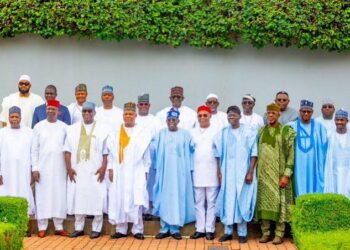
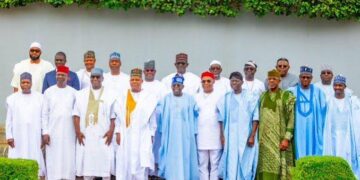
In a communiqué at their meeting at the Iperu residence of Ogun State Governor Dapo Abiodun on Monday, November 24, they underscored the crucial role of traditional institutions in national stability, especially in intelligence gathering and grassroots security, citing “their proximity to local communities and capacity to provide early-warning intelligence,” and urged states to formally integrate traditional rulers into their security councils.
Welcoming the attendees, Governor Abiodun, chair of the forum, reaffirmed that the creation of state police is “non-negotiable,” as a key step in addressing rising insecurity across Nigeria, adding that a “policing model closer to local communities will enhance safety, improve intelligence gathering, and strengthen early-warning systems.”
Lately, Zamfara State Governor Dauda Lawal “swore to Almighty Allah” on September 3, that he knew and, via his phone, could show the locations of bandit leaders in the state; and that “banditry would end in two months” if he’d the power of control over security agencies.
In a viral video, Lawal’s frustration boiled over, lamenting that, “Most of the time, I shed tears for my people because I can see a problem but cannot order security operatives to act in time. We have entrusted everything to God and surely, He will come to our rescue.”
Having “control over security agencies” means the possession of authority to direct and deploy a law enforcement, whose head doesn’t take or wait to take “orders from Abuja” whenever there’s fire of insecurity in the state, but from the governor, who’s constitutionally the Chief Security Officer of the state. And this is where state police comes in!
In the wake of Governor Lawal’s concerns, the Northern Elders Forum (NEF) asked the Federal Government to declare a “State of Security Emergency in Northern Nigeria,” while President Tinubu promised to refocus attention on the creation of state police.
In a communiqué signed by its spokesperson, Prof. Abubakar Jiddere on September 3, the NEF noted that security agencies “remain overstretched, under-resourced, and in some cases complicit through silence or inaction, leaving citizens vulnerable and eroding public trust in government,” recalling three separate attacks in Zamfara and Kaduna, which left about 80 dead, including 35 executed by the bandits despite ransom payments, and many injured and others abducted.
“These incidents are not isolated cases but part of a persistent pattern of organised criminal violence and banditry that have claimed thousands of lives, displaced hundreds of thousands, crippled economic activities, undermined food security, and inflicted deep psychological and social trauma on communities,” the forum said.
Warning that “continued inaction or insufficient responses will not only exacerbate human suffering but also jeopardise national cohesion, democratic sustainability, and regional peace,” the NEF urged the government to deploy adequately-trained and equipped security forces with clear rules of engagement, to protect civilians, secure border regions, and provide compensation, rehabilitation, and humanitarian support to victims, including displaced persons.
On the same September 3 at the State House, Abuja, President Tinubu, during a meeting with members of the Northeast Governors Forum, led by Borno State Governor Babagana Zulum, said his administration would work closely with the leadership of the National Assembly, “to remove political and bureaucratic bottlenecks” stalling the establishment of state police.
Saying the time had come for “a clear, collective path towards community-based policing that reflects the peculiar needs of different regions,” Tinubu declared: “I have been looking at the security situation more carefully. I have seen the Civilian JTF (a Joint Task Force of security agencies and local volunteer groups in the North-East) react to the security challenges, finding so many creative ways to protect neighbourhoods and communities around you, and that provoked my thinking about state police again.
“Politics apart, we can discuss with the National Assembly leadership to really look at a critical path to that again, see how we can eliminate or douse political alliances from state police that will be indigenous to the community and provide the additional safety buffer and effectiveness in the area. We have to look at it collectively together,” Tinubu said.
He noted that “political concerns around state police will always surface,” but they must not be allowed to derail urgent security reforms, adding that his government was committed to ensuring that the proposed structure “will be insulated from partisanship and designed purely to strengthen safety across communities.”
Time and again, the security situation in Nigeria has elevated creation of state police to national discourse. But the consensus around its establishment waned as quickly as it’s mooted, leaving security worse off than previously.
The call for state police initially received less enthusiasm from state governors, especially the 19 Northern governors, whose regional interest appears to override consideration for security, making it difficult to scale the requirements for its creation.
Recent upsurge in terrorism, banditry, kidnapping and other forms of criminality across Nigeria, particularly in the North Central, North-East, and North-West zones, has prompted a rethink by the 19 governors to endorse state police.
In May 2025, the governors “formally approved the proposal for state police, citing the need for more effective, locally-driven security management,” and urged the National Assembly “to expedite work on necessary legislation to enable its establishment.”
In the last count by mid 2025, about 34 of Nigeria’s 36 state governors had indicated interest to form state police. But when the chips were down on September 18 for a collective action, the National Economic Council (NEC), empowered to process and facilitate the policy for transmission to the Executive Council of the Federation (ECF), commonly referred to as Federal Executive Council (FEC), failed to act.
The NEC didn’t even list state police on the agenda for its 152nd meeting in Abuja under the headship of Vice President Kashim Shettima, with a report by The Nation on September 19 headlined, “Again, NEC dithers on state police deliberation, adoption,” stating that, “it was reported that the matter was stepped down at a previous session.”
Besides sectional interest, why the dithering on state police? FEAR, media talking heads parrot regularly! Fear that dubious-minded individuals: governors, politicians, and persons of power and influence will misuse the system to settle scores.
For crying out loud, isn’t misuse of a centralised police force for selfish ends rampant in Nigeria? Aren’t we witnesses to the unnecessary allocation of thousands of police officers to VIPs, leaving huge gaps in adequate policing and coverage of vulnerable areas nationwide?
The issue is the number of police personnel available for law enforcement, as President Tinubu’s order for “immediate” withdrawal of 100,000 police officers from VIPs, to be redeployed for regular policing, has confirmed the misuse of federal police!
The moves against state police appear to go beyond the fear of its misuse. The governors’ no-show stems from accountability they don’t render for the huge monthly allocations for “security votes” that allegedly serve as conduits for official looting.
The creation of state police will make it difficult, if not impossible, for governors to continue to allocate hefty amounts for security votes, as these will be redirected to funding more expensive law enforcements, which are budgeted for and over sighted by the State Houses of Assembly.
As of November 2025, the Nigeria Police has about 371,800 officers, with over 200,000 serving the elite (VIPs), leaving 171,800 officers to police 236.7m Nigerians. With this abysmal number, the security situation in Nigeria has long past “a stich in time saves nine.”
The spike in insecurity, and return of abductions of schoolgirls across Northern Nigeria, should tutor the governors and others opposed to State Police to move away from catering to selfish interests, and support its creation and establishment now, not later! And President Tinubu should fix it as one of the security challenges he says “are surmountable!”
* _Mr Ezomon, Journalist and Media Consultant, writes from Lagos, Nigeria.