








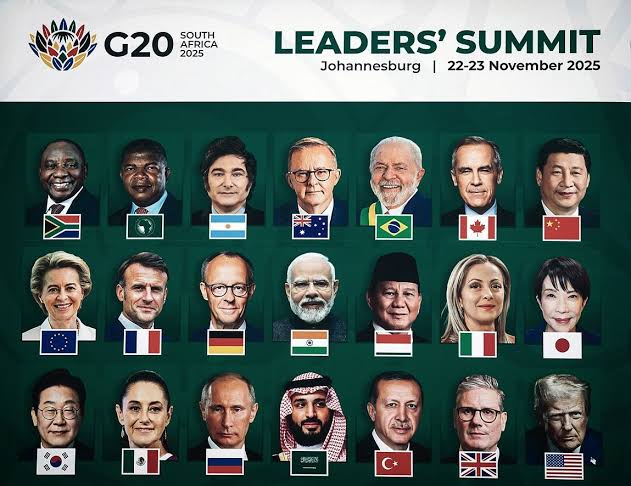

The opening of the G20 Summit in Johannesburg marks a historic moment—not merely because it is the first time the world’s leading economies are convening on African soil, but because the gathering has proceeded with a conspicuous absence: that of the United States. President Donald Trump’s decision neither to attend nor to send an official representative is more than a diplomatic discourtesy; it is a deliberate withdrawal from collective global responsibility at a moment when cooperation is most needed.
Tensions between Washington and Pretoria have simmered in recent months. President Trump’s unfounded allegations that South Africa’s ANC-led government illegally seized land from white citizens—claims repeatedly debunked—set the stage for strained relations. His administration’s subsequent immigration policy, which privileges white South Africans and allocates more than half of America’s 2026 migrant quota to them, represents a troubling reorientation of U.S. foreign policy with racial undertones.
The practical implications of the United States’ no-show are also significant. As South Africa prepares to hand over the G20 presidency to the U.S. next year, the absence of an American delegation raises procedural and symbolic questions about continuity and commitment within the group.
Yet, despite this diplomatic disruption, the summit opened with striking unity and purpose. Leaders from Europe, Asia, and Australia—joined by China, Japan, Germany, France, and others—demonstrated an unusual early consensus by issuing a declaratory resolution at the very start of the meeting. The communiqué underscores long-standing global priorities: advancing peace, combating climate change, addressing poverty, mitigating food insecurity, and narrowing regional inequalities.
In doing so, the G20 has signaled its determination to act collectively even when the world’s most powerful economy declines to participate constructively. Their explicit commitment to pursue lasting peace in regions plagued by conflict—including the Democratic Republic of Congo, Sudan, Ukraine, and Palestine—stands in sharp contrast to the Trump administration’s dismissiveness toward multilateral peace efforts and its continued portrayal of climate change as a “hoax.”
President Cyril Ramaphosa’s opening address provided the moral and political foundation for this unified stance, affirming Africa’s growing insistence on being a central actor—not an afterthought—in global decision-making.
Meanwhile, geopolitics continues to intrude upon the margins of the summit. European and British leaders are expected to engage President Volodymyr Zelensky of Ukraine on President Trump’s controversial 28-point peace plan. Trump has set an ultimatum: accept or reject the proposal by Thanksgiving Day. Zelensky has assembled a negotiating team to assess a plan he openly acknowledges as “difficult,” even as Russia consolidates its occupation of roughly 20 percent of Ukrainian territory and pushes forward on multiple fronts.
The Johannesburg summit thus becomes more than a diplomatic event; it is a test of global resolve. In the face of American retrenchment, other world powers appear willing—indeed compelled—to step into the leadership vacuum.
The question now is whether the G20 can sustain this unity beyond Johannesburg and translate its declarations into meaningful action.